
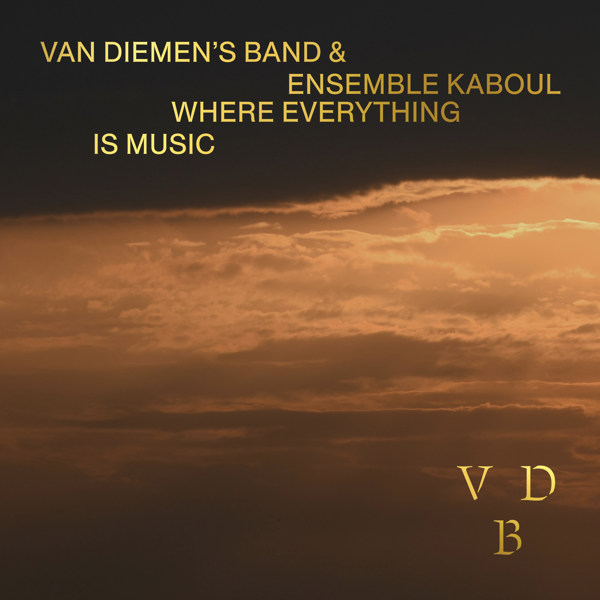
Where Everything is Music
The Persian music of Afghanistan meets Baroque in this acclaimed cross-cultural collaboration with Ensemble Kaboul.
Experience a stunning blend of two distinct musical worlds, when the warm, resonant tones of Van Diemen's Band meets the intricate melodic patterns of traditional Afghan and Persian music, while soaring vocals merge with the ethereal late 19th century piano compositions of Erik Satie.
Embodying artistry and advocacy, this recording preserves and celebrates musical traditions Afghanistan's current regime is attempting to silence.
Where Everything is Music is now available on available on all major streaming platforms and CDs can be ordered from our online Shop.

Now available!
The full album of Where Everything is Music is now available to stream or download on all major platforms.
Order your copy today
Recorded at Mona's Frying Pan Studios in September-October 2025, the latest release on the VDB Label features the acclaimed collaboration between VDB and Ensemble Kaboul.
CDs are now available to buy
Working with Van Diemen’s Band has been one of the most meaningful artistic journeys of my recent years.
I first collaborated with the ensemble in 2023, and since then our musical dialogue has grown into something far deeper than a professional partnership. Returning to Tasmania in September 2025 for our second project together felt like coming back to a musical family.
This recent recording in Hobart was centred around a programme that brought together traditional Afghan pieces, works proposed by Van Diemen’s Band, and original compositions by my dear friend and outstanding virtuoso Luke Plumb, through whom this collaboration was first initiated. His artistic vision created the bridge that allowed our musical worlds to meet.
The project was further enriched by the beautiful and refined arrangements of the ensemble’s harpsichordist and classicist, Donald Nicolson, whose sensitivity to texture and structure gave the repertoire both clarity and depth.
On the Afghan side, the presence of the remarkable singer Siar Hashimi and his brother, the percussion virtuoso Masud Hashimi, brought a particularly powerful and moving dimension to both the concert performances and the recording sessions. Their expressive intensity, rhythmic vitality, and deep connection to the Afghan tradition added authenticity and emotional depth to the project. In the studio especially, their musical dialogue with the ensemble created moments of rare sincerity and spontaneity.
What moves me most about this group is not only its extraordinary artistic level, but also its openness — the generosity with which it embraces different traditions and allows them to breathe within early music practice.
Over time, I have developed deep affection and sincere friendship with the musicians. There is a rare authenticity in the way this ensemble listens — to one another, to history, and to the present moment. Our collaboration is built on trust, curiosity, and shared emotion.
I am profoundly grateful to be part of this musical adventure and look forward to the next chapters we will create together.
Khaled Arman
Ensemble Kaboul
There are moments in music when the distance between cultures dissolves — when two entirely different traditions, shaped by different histories, different instruments, different centuries, find that they have always, in some sense, been speaking to one another.
This recording is one of those moments.
Van Diemen's Band, whose work is rooted in the music of seventeenth and eighteenth century Europe, and Ensemble Kaboul — three Afghan musicians of extraordinary distinction, Khaled, Siar and Masud — have come together to explore the threads that quietly connect Western classical music with the profoundly rich musical heritage of Afghanistan.
The program moves in both directions: Van Diemen's Band perform arrangements of melodies from Afghanistan's deep and ancient tradition — tunes that any Afghan would know and carry in their heart, speaking of home with an intimacy no prohibition can erase. The musicians of Ensemble Kaboul, meanwhile, bring their distinctive voices to works from the Western classical tradition, pieces chosen precisely because they elude easy categorisation, offering the perfect common ground for two traditions to meet and play. What emerges is not a collision, but a conversation: tender, generous, and deeply human.
This collaboration carries a weight beyond the purely musical. The Afghan musicians of Ensemble Kaboul are masters in the fullest sense — yet they are no longer free to play their own music in the country of their ancestors. Sit with that for a moment. And yet here they are, not diminished but defiant, sharing that music with the world, ensuring it is heard, preserved, and honoured.
To play alongside them is a privilege. Within moments of beginning, the differences of tradition fall away, and there is only the music itself — alive and shared.
This is an act of preservation, and a reminder that people from vastly different worlds can create something genuinely beautiful together. These musicians are proof of that. Every note is offered with craft, with humility, and with love.
Julia Fredersdorff
Artistic Director, Van Diemen's Band
| Ensemble Kaboul |
KHALED ARMAN rubab |
| Van Diemen's Band |
JULIA FREDERSDORFF Artistic Director & Baroque violin
LUKE PLUMB mandolin
KATIE YAP Baroque violin
RACHEL MEYERS viola
LAURA VAUGHAN viola da gamba & violone
MARTIN PENICKA cello
DONALD NICOLSON harpsichord
|
ENSEMBLE KABOUL explores the Persian music of Afghanistan, an unrecognised or even forgotten repertoire. In this country, rich with several musical cultures, the traditional and sacred Persian heritage testifies to a remote past and of a particular poetry. Persian cultural influence can be experienced from Lahore to Budapest and from Erevan to Cordoba.
To bring this repertoire back to life, the Ensemble Kaboul works like archeologists in order to rediscover the buried musical themes, the missing ornaments and the lost motifs of a formerly flourishing musical corpus. To renovate these buried mosaïcs, Ensemble Kaboul gathers musicians who belong to a large Persian musical family spread over numerous countries.
KHALED ARMAN (rubab) is one of the most famous players of Afghan lute, the rubab. He introduced the instrument to the Persian, Indian and European music traditions (ancient, classical and contemporary music) when it was strictly associated with the folk repertoire. He has collaborated with viola da gamba players such as Jordi Savall and Vittorio Gielmi, performed with the Grand Eustache Orchestra in Lausanne and with the Quatuor Barbaroque in France. He writes new compositions and orchestrations for Ensemble Kaboul, works inspired by the Afghan tradition and his musical experience while living in France. He fights for the survival of this instrument in his country.
SIAR HASHIMI (tabla, voice) started learning the tabla in Kabul at the age of 4 with teacher Ustad Wali Mohammad. He then completed his training in India and Germany with masters Zakir Hussain, Anindo Chaterjee and Kumar Bose. He began working at a young age with Afghan immigrant artists Farhad Darya, Ustad Mahwash, Amad Wali as well as several big names in Indian classical music such as Hariprasat Chaurasia. In addition to the tabla, he is also a leading exponent of traditional percussion such as the zerbaghali, the dolak, and the daf.
MASUD HASHIMI (zerbaghali, percussion) is recognized as one of the most creative percussion players in the Afghan music industry. Masud has had the opportunity to participate in numerous music festivals around the world, where he has been honored with several prestigious awards. Coming from a musically inclined family, Masud began his musical journey at the age of three. He started learning percussion instruments at a very young age and continued to deepen his knowledge by studying under renowned European and Afghan instructors. Today, Masud is a well-known figure within the modern Afghan community across Europe and the United States. He frequently performs on stage with some of the most famous Asian artists, captivating audiences with his rhythm and talent.
‘Where everything is music…’ (Rumi, 13th century)
Van Diemen’s Band’s fourth album on the in-house VDB label captures a cross-cultural collaboration with members of the legendary Ensemble Kaboul. Created originally for Tasmania’s MONA FOMA 2023 festival, the program subsequently toured Australia to critical and audience acclaim in 2025.
Ensemble Kaboul's practice encompasses both advocacy and preservation, using performance to keep alive a musical culture that Afghanistan’s current regime is forcefully attempting to extinguish, as has been the case several times over the past half-century. The group’s core instruments—rubab (lute), tabla and zerbaghali (hand drums)—anchor the sound, bringing rhythmic vitality and a distinctive tonal colour throughout.
What emerges in this recording is a striking blend of musical worlds: the grainy warmth of VDB’s gut strings and ‘period’ sound of harpsichord alongside traditional Eastern instruments, and the melisma of Afghan singing set against the elliptical piano music of Erik Satie. Persian music has been arranged by Khaled Arman for this unusual combination, while Western works have been chosen and adapted for their openness of style, offering a point of aesthetic contact.
It is tempting, from a Western vantage point, to describe this as a meeting of ‘art’ and ‘popular’ traditions; yet in Afghan musical culture the line between the two has always been blurred. The same musical language runs through both extended, reflective raga forms, and the shorter songs heard at gatherings, or on the radio. Afghan popular music is not harmonically simplified Western pop; rather, it is a distilled form of art music thinking. Its melodies carry the same shapes, ornaments and emotional turns, simply in more compact form.
This closeness is deepened by the role of poetry. Classical Persian verse, especially that of the great Sufi poets, moves easily between music genres, so that popular music retains the same literary depth and symbolic richness associated with art music. The instruments themselves travel just as freely, creating a shared sound world instinctively recognised by local listeners.
In this light, what you hear in this program is less a meeting of opposites than an extension of an already flexible tradition. The Afghan material finds ready companions in Western works that favour openness and suggestion, whether in the suspended stillness of Satie or the patterned grace of the Baroque.
The opening track is a lively demonstration of this, in which the Shur (Phrygian-mode) setting of the late twentieth-century Persian instrumental melody NAGHMA-E KABOULI is juxtaposed with a gavotte from J.S. Bach’s eighteenth-century Lute Suite in G minor, BWV 995, itself an arrangement by the German master of his earlier Cello Suite No 5.
Composer and singer Fazel Ahmad Zekrya, also known as ‘Nainawaz’, wrote AY NAY-NAWÂ to a poem by the Sufi mystic Rumi. It describes the ney’s (reed flute’s) longing to return to its reed bed; an image of separation from one’s source and the path toward human maturity.
VDB violist Rachel Meyers draws on her Jewish heritage and research into Renaissance music in an arrangement of the ancient Ladino song YO M’ENAMORI D’UN AIRE. The lyric describes falling in love with a beautiful woman, and its melodyhas crossed the Mediterranean basin, making it a perfect fit for the diverse instruments in the ensemble.
Mandolinist and composer Luke Plumb, whose career spans classical and folk music performance, and who was a long-time member of the renowned Scottish band Shooglenifty, contributes MORE THAN MEMORY. He writes:
‘More Than Memory is from 'The Ten Titles Project' (2009), ten titles to serve as inspiration for creative expression in any field, taken from shared human experience. More Than Memory combines nostalgia for childhood innocence, recollections that become jumbled and disjointed over time and the acknowledgment of formative moments in character building.’
VDB harpsichordist and musicologist Donald Nicolson bends the West towards the East in arrangements that draw fully on the improvisatory gifts of Ensemble Kaboul’s musicians. The melodic line of Erik Satie’s GNOSSIENNE NO 1 for piano suggests to Nicolson ‘…the sounds of the mystical East’ and becomes the basis for a vocal reimagining by Siar.
By contrast, the voices of Hildegard von Bingen’s medieval nuns are removed from her plainchant O VIRTUS SAPIENTIAE (O strength of wisdom), and its formerly free line anchored by driving Eastern rhythms in a purely instrumental rendition tinted with ornamental devices from Byzantine and Turkish music, creating a hypnotic effect.
DEL DÂDAM is a popular love song that used to be sung at Afghan festivals. In keeping with the program’s time-travelling spirit, Khaled’s version makes a brief detour into French Baroque pastiche inspired by the music of Michel Delalande (1657-1726), composer for Louis XIV’s court at Versailles.
The legendary Nainawaz, executed in 1979 for taking part in an uprising against his country’s ruling Khalq government just prior to the start of the Soviet-Afghan War, also supplies DAR DÂMAN-E SAHRÂ. In it, a mystic wanders in the desert, listening to the ‘melody of existence’ and its revelation of the secret of eternal love.
Like many seventeenth-century French composers, Antoine Boësset was drawn to themes of timelessness and the ephemeral nature of existence. In the song NOS ESPRITS LIBRES (Our free spirits), Nicolson liberates the lilting eight-bar chordal progression from the original text and allows a blurring between the sounds of strings going off-piste and a reminiscence of the Satie Gnossienne heard earlier. (Not on the CD release.)
Our Afghan guests return exclusively to their patch with an instrumental conversation that takes as its starting point a popular melody called YA RASUL ALLA. Unlike the soloistic basis of improvisation in Western jazz, the Afghan version is based on a three-way exchange that rapidly escalates in intensity and virtuosity.
The cultural mix on this recording reaches its dramatic height in the final track. Melodies from opposite hemispheres, composed some 350 years apart, are superimposed: a seventeenth-century Scottish pibroch (an extended theme-and-variation form associated with the bagpipes; the word means ‘piping’ in Scottish Gaelic) and an Afghan hit song from this century.
CUMHA NA CLOINNE (‘Lament for the Children’) was composed by Pàdraig (Patrick) Mòr MacCrimmon, a piper to the Clan McLeod on the Isle of Skye, after seven of his eight sons died in a smallpox epidemic. In our time, the song MAADARAM (My Mother) written by revered popular singer Farhad Darya for his 2003 studio album Salaam Afghanistan, recasts the lament as that of a son to his mother, extending it to the suffering of many mothers – and of his country.
It was Siar who pointed out the two melodies share an identical harmonic mapping, allowing Maadaram to be placed neatly atop the arrangement of the Lament that Donald Nicolson had already made for the group in 2021. The effect is stunning: played on mandolin rather than pipes, MacCrimmon’s melody – described by the poet Sorley MacLean as ‘the greatest of all Scottish works of art’ – grows increasingly intense through repetition, speaking to a single family’s mourning; while the broader tragedy evoked in the major key tonality of Darya’s song is delivered with an exhausted calm that the older melody, its harmonic setting becoming more uneasy, seems to resist.
If this playlist feels cohesive, it may be because the distance between European baroque music and Afghan practice is smaller than it first appears. Both favour variation over fixity, and both depend on the performer’s hand in shaping the music. Rumi’s image of a world ‘where everything is music’ offers an apt way of hearing this meeting. Here, the boundaries between art and popular expression, between cultures, and between past and present, soften and give way, and each tradition finds its echo in the other.
© Christopher Lawrence 2026
AY NAYNAWÂ Lyrics: Maulana Jalal-Al din Bakhi
بشنو از نی چون حکایت میکند
از جداییها شکایت میکند
کز نیستان تا مرا ببریدهاند
از نفیرم مرد و زن نالیدهاند
هر کسی کو دور ماند از اصل خویش
باز جوید روزگار وصل خویش
آتش عشق است کاندَر نی فتاد
جوشش عشق است کاندَر می فتاد
نی حدیث راه پُرخون میکند
قصههای عشق مجنون میکند
Listen to this reed how it complains,
It tells the tale of separations and pains.
Since from the reed-bed they cut me free,
Men and women have lamented through me.
I long for a heart torn piece by piece from separation,
So that I may explain the pain of desire and aspiration.
Whoever remains distant from their own origin,
Seeks again the time of reunion with it.
In every gathering I became sorrowful,
I joined both the sorrowful and the joyful.
Everyone became my companion according to their own understanding,
Yet none sought the secrets hidden within me.
My secret is not far from my wail,
But eyes and ears lack the light to perceive it.
The body is not hidden from the soul, nor the soul from the body,
Yet no one has the vision of the soul granted.
This sound of the reed is fire, not mere wind,
Whoever lacks this fire, let them vanish.
YO M’ENAMORI D’UN AIRE Lyrics: Traditional Ladino
Yo me enamoré de un ayre; de un ayre de una mujer.
De una mujer muy hermoza linda de mi corazón.
Yo me enamoré de noche, y la luna me engañó.
Si otra vez yo me enamoro, sea de día y con sol.
I fell in love with a breeze; A breeze of a woman.
Of a woman so beautiful, dear one of my heart.
I fell in love at night, and the moon deceived me.
If I fall in love again, it would be by the sunlight of day.
DEL DÂDAM | Being With You Was a Mistake
بیجا به تو من دل باختم
افسوس که تو را نشناختم
تو عشقت در دلم هر دم فزودی
به صد افسون دل و جانم ربودی
شناختم دلبرا، ای جان، تو را من
همان چیزی که میگفتی نبودی
به گوشم نغمهی هستی سرودی
به من قول و قسم پیمان نمودی
کنون بیجا شکستی عهد و پیمان
نبودی لایقِ عشقم، نبودی
Being with you — a choice I regret,
A love I never should've met.
Your love grew in me, day by day,
With vows and promises you’d gently say.
I came to know you, dearest one, so true,
Yet you were never the one I thought I knew.
You sang to me a melody of peace,
With words of love that brought sweet release.
But now you've broken every vow and line—You were never worthy of this heart of mine.
DAR DÂMAN-E SAHRÂ
در دامنِ صحرا بیخبر از دنیا
خوانده به گوشم میرفت
نوای هستی را
آن که به نقش زمانه دل نبندد
نغمهی عشق و هوای دل پسندد
این نوای آسمانی با تو گویم
گر ندانی راز عشق جاودانی
از بیگناهیِ تو غرق گناهم من
تشنهی دردم مهر تو را میخواهم من
خوش بود ای گل، ناز تو را کشیدن
با قیمت جان روی مهِ تو دیدن
برده تابم تاب گیسو
کرده چهره چشم جادو
دیده یکسو آن دو گیسو
In the embrace of the desert, unaware of the world,
I heard the melody of existence calling.
He whose heart is not bound by the patterns of time,
Finds the tune of love and the breeze of the heart’s desire.
This celestial tune, whom shall I tell if you do not know,
The secret of eternal love.
In the embrace of the desert, unaware of the world,
I heard the melody of existence calling.
From your innocence, I am drowned in sin,
Thirsting for your pain, I seek the melody of existence.
He whose heart is not bound by the patterns of time,
Finds the tune of love and the breeze of the heart’s desire.
This celestial tune, whom shall I tell if you do not know,
The secret of eternal love.
MAADARAM
Your scarf became wet with your tears
You spent your life crying
Sleep evaded your eyes
And they took away your smile
My dear mother, I want to die for you
And I want to be the earth under your feet
Because you suffered so much for me.
|
ما در جایی افتادهایم که همه چیز موسیقی است. نواهای چنگ و نی به جو میرود، و اگر تمام هارپ دنیا بسوزد، هنوز هم سازهای پنهانی در حال نواختن هستند. این هنر آواز کف دریا است. حرکات زیبا از مرواریدی در جایی در اعماق اقیانوس میآید. شعرها مانند جزر و مد و لبه چوبهای دریا به سمت بالا میرسند، خواستن! آنها از ریشهای کند و قدرتمند که نمیتوانیم ببینیم، برمیخیزند. اکنون کلمات را متوقف کن. پنجرهای در مرکز سینهات باز کن، و بگذار روحها بیایند و بروند. |
Don’t worry about saving these songs! We have fallen into the place The strumming and the flute notes So the candle flickers and goes out. This singing art is sea foam. Poems reach up like spindrift and the edge They derive Stop the words now. Translation: Coleman Barks |
Executive Producer Julia Fredersdorff
Recording Producer Christopher Lawrence
Sound Engineer Erick Jaskowiak
Sound Editing Luke Plumb
Mixing & Mastering Calum Malcolm
Operations Manager Dirk Lorenzen
Artist Coordinator Katie Yap
Recorded at Frying Pan Studios 29 September - 3 October 2025.
Our deepest thanks to Brian Ritchie, Christopher Lawrence, Luke Plumb, Gaia Ceresera, Chris Townend & Eliza Bird / Frying Pan Studios and Renee Millard / Travel Managers.
We are very grateful to all of the amazing donors and supporters who contributed to the fundraising campaign that made this recording possible:
Dominique Baker, Eva-Maria Bernoth, Hetty Binns, Kim Bishop, Rachel Boersma Plug, Carmen Burnet, Sarah Challenor, Wendy Cobcroft, Julian Cornish, Moya Costello, Phil Crawford, David Day, Tamara Foster, Marguerite Foxon, Christine Gardner, Liz Gillam, Sarah Gillman, Matthew Goddard, Philip & Leanne Good, Karen Hall, Catherine Hayman, Felix Hayman, Janina Jankowski, Miriam Johnson, Brendan Joyce, Patricia Kowal, Val Kyrie, David & Susan Mantle-Price, Tracy Matthews, Alexandra McCallum, Wendy McLeod, Rachel Meyers, Carol Nichols, Indigo O'Neill, Madeleine Ogilvie, Scott Parkes, Sandra Penicka, Ann Pickering, Judy Quinn, Sarah Rubenach, Harley Russell, John Sexton, Christiane Smethurst, Ann Stark, Drew Thomas, Barbara Thorsen, Jennifer van Dijk, Anne Warby, Roland Warner, Anthony Weidenbach, Penelope Wellham, Andrea Wild, Ruth Wilson, EddiefromLonnie, Anonymous x 10
This project has been assisted by the Australian Government through Creative Australia, its principal arts investment and advisory body, by the Tasmanian Government through Arts Tasmania, and by the Swiss Arts Council.


